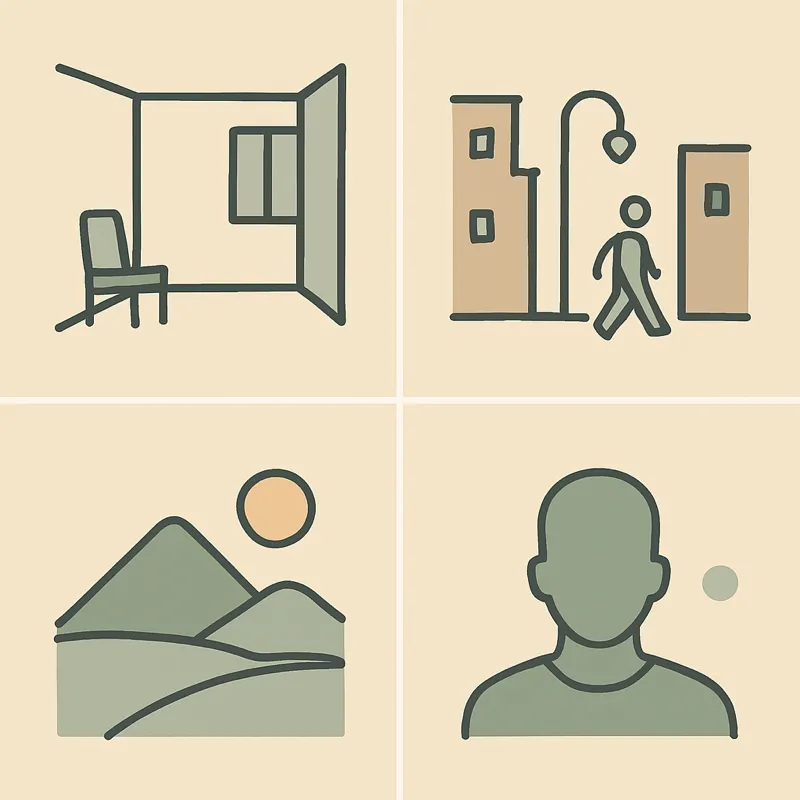
One of the most fundamental aspects of photography is understanding how focal length affects your images. Whether you’re using a smartphone or a professional DSLR, the focal length of your lens dramatically changes the way your photos look.
What is Focal Length?
Focal length, measured in millimeters, is the distance between the optical center of the lens and the camera’s sensor when focused at infinity. This technical definition might not mean much to beginners, but think of it this way: focal length determines how much of the scene your camera captures and how magnified it appears.
Shorter focal lengths (wide-angle) capture more of the scene, while longer focal lengths (telephoto) capture less of the scene but make distant objects appear larger.
Quick Focal Length Comparison
| Focal length on full frame | View | Common uses |
|---|---|---|
| 16mm | Ultra-wide | Interiors, architecture, dramatic landscapes |
| 24mm | Wide | Landscapes, travel, environmental scenes |
| 35mm | Moderately wide | Street, documentary, environmental portraits |
| 50mm | Normal | Everyday photography, portraits, products |
| 85mm | Short telephoto | Head-and-shoulders portraits, details |
| 200mm | Telephoto | Sports, wildlife, distant subjects |
These categories assume a full-frame camera. Apply your camera’s crop factor when comparing the field of view on another sensor size.
Common Focal Length Ranges
Let’s explore the different focal length ranges and what they’re typically used for:
Ultra-Wide Angle (9-24mm)
Ultra-wide angle lenses are perfect for:
- Architecture and interiors
- Landscapes where you want to capture vast scenes
- Real estate photography
- Astrophotography
At these focal lengths, you can capture an extremely wide field of view, but there’s often noticeable distortion, especially at the edges.
Wide Angle (24-35mm)
Wide angle lenses are versatile for:
- Street photography
- Environmental portraits
- Landscapes
- Indoor photography where space is limited
These focal lengths still capture a broad scene but with less distortion than ultra-wide lenses.
Normal (35-70mm)
Normal focal lengths (around 50mm on full-frame cameras) are closest to the human eye’s natural perspective. They’re ideal for:
- Documentary photography
- Everyday snapshots
- Street photography
- Environmental portraits
The 50mm is often called a “nifty fifty” and is a popular first prime lens for beginners due to its versatility.
Short Telephoto (70-135mm)
Short telephoto lenses excel at:
- Portraits (85mm is a classic portrait focal length)
- Street photography where you want more distance
- Event photography
- Detail shots
These focal lengths provide pleasing compression and background blur, making subjects stand out.
Telephoto (135-300mm)
Telephoto lenses are essential for:
- Sports photography
- Wildlife photography
- Performance photography
- Candid shots where you can’t get close
These longer focal lengths significantly compress perspective and isolate subjects from their backgrounds.
Super Telephoto (300mm+)
Super telephoto lenses are specialized for:
- Wildlife photography (especially birds)
- Sports from a distance
- Astronomy
- Surveillance
These lenses require special handling techniques due to their size and weight, often needing tripods or monopods for support.
How Focal Length Affects Your Images
1. Field of View
The most obvious effect of focal length is on your field of view. As focal length increases, your field of view narrows.
2. Perspective Distortion
Focal length affects how objects appear in relation to each other:
- Wide-angle lenses tend to exaggerate the distance between foreground and background elements. Objects close to the lens appear larger, while objects farther away seem much smaller.
- Telephoto lenses compress perspective, making distant objects appear closer to foreground elements.
3. Depth of Field
While aperture is the primary controller of depth of field, focal length plays a role too:
- Longer focal lengths create a shallower apparent depth of field
- Wide-angle lenses generally produce deeper depth of field
4. Background Blur (Bokeh)
Longer focal lengths can create more pronounced background blur, which is why 85mm and 135mm lenses are popular for portraits.
Choosing the Right Focal Length
When deciding which focal length to use, ask yourself:
- What elements of the scene do I want to include or exclude?
- What perspective effect am I trying to achieve?
- How much separation do I want between my subject and the background?
- What’s the practical situation (how much space do I have to move around)?
Remember that focal length is a creative choice, not just a technical one. Each focal length tells stories differently.
Worked Example: 35mm on Full Frame and APS-C
A 35mm lens on full frame gives a moderately wide view that is popular for street and documentary photography. Put the same 35mm lens on a 1.5× APS-C camera and its field of view is similar to 52.5mm on full frame: 35 × 1.5 = 52.5. That is much closer to a normal view.
To reproduce the original 35mm full-frame framing on a 1.5× APS-C body, use roughly a 23mm lens: 35 ÷ 1.5 = 23.3. A common 23mm or 24mm lens will be close.
Using Our Lens Comparison Tool
If you’re curious about how different focal lengths render a scene, try the preconfigured comparison above or build your own comparison with the interactive lens tool. This tool allows you to:
- Visualize the field of view for different focal lengths
- Compare multiple lens configurations side by side
- See how crop factor affects your effective focal length
- Understand the relationship between focal length and perspective
Whether you’re shopping for a new lens or just trying to better understand the equipment you already have, visualizing these differences can be incredibly helpful.
Conclusion
Mastering focal length is one of the fundamental skills in photography. It’s not just about getting closer or farther from your subject – it’s about how you choose to represent space, dimension, and relationship in your two-dimensional image.
The next time you’re shooting, try experimenting with different focal lengths to see how they change your perspective. You might find that a different focal length than your usual choice gives your images a fresh and interesting look.